
The Great Unplugging: Why Wireless Power Is Finally Here to Stay
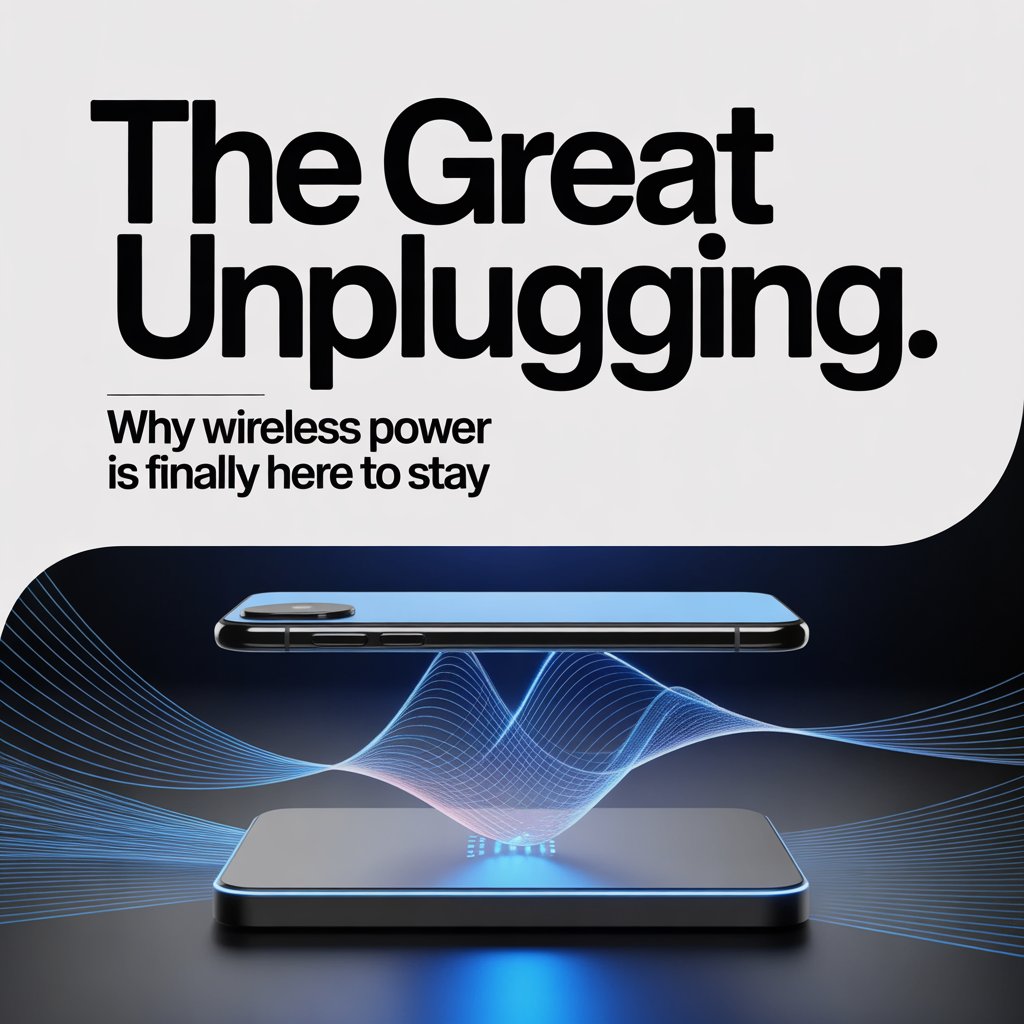
Cutting the Last Cord
Imagine a world where charging is something that happens automatically, where you never hunt for an outlet, never untangle cables, and never watch your device battery percentage with anxiety. This isn’t science fiction; it’s the emerging reality of true wireless power. After decades of promises and false starts, we’re on the verge of cutting technology’s last physical tether: the power cord.
From Qi to Room-Scale: The Evolution of Wireless Charging
First-generation wireless charging (Qi standard) gave us charging pads, a minor convenience that still required precise placement. The next generation, led by companies like Energous and Wi-Charge, is breaking free from surfaces entirely.
Infrared laser charging can now safely deliver power across rooms, turning any surface with a receiver into a charging spot. Radio frequency harvesting technologies can pull usable energy from ambient Wi-Fi and cellular signals. But the real breakthrough comes from magnetic resonance systems that can charge multiple devices anywhere in a defined space, whether they’re in your pocket, on a table, or across the room.
The Infrastructure Revolution
Wireless power requires rethinking our environments. Companies are now building it into the fabric of spaces:
-
Legrand and Eaton offer wireless power building blocks for commercial spaces
-
Apple’s rumored full-home wireless charging ecosystem
-
IKEA’s furniture with integrated wireless charging surfaces (and soon, volumetric charging zones)
-
Automotive companies embedding charging pads in car consoles, door panels, and even seatbacks
This isn’t just about convenience, it’s about enabling new device forms. Without battery compartments and charging ports, designers can create fully sealed, waterproof, dustproof devices with uninterrupted surfaces and novel shapes.
The Battery Paradox: Less Is More
Paradoxically, wireless power might mean smaller batteries, not larger ones. When devices can continuously “sip” power from their environment, they don’t need massive battery reserves for all-day use. This could lead to thinner phones, lighter AR glasses, and truly miniaturized wearables that never need conscious charging.
The Medical Breakthrough
Perhaps the most profound impact will be in medical technology. Implantable devices—pacemakers, neural stimulators, drug delivery systems, currently require risky replacement surgeries when batteries deplete. Wireless power enables permanent implants that receive power through the skin, eliminating the most dangerous aspect of these life-saving technologies.
Challenges and Safety
Legitimate concerns remain about efficiency and safety. Current wireless systems lose more energy than wired charging, though newer resonant systems achieve 80-90% efficiency. Safety standards from IEEE and FCC are evolving rapidly, with strict limits on electromagnetic exposure and intelligent systems that detect foreign objects (like keys or coins) to prevent unwanted heating.
The Sustainability Question
Wireless power could be either an environmental disaster or triumph, depending on implementation. Inefficient systems waste electricity, but smart implementations could actually reduce electronic waste:
-
Fewer charging cables manufactured and discarded
-
Longer device lifespans (no worn-out charging ports)
-
Smaller batteries using fewer rare-earth minerals
-
Optimized charging that extends battery health
Your Wireless-Powered Tomorrow
In five years, you might:
-
Walk into cafes, airports, or offices where your devices automatically maintain charge
-
Own a car that charges your phone, watch, and earbuds as you drive
-
Live in a home where nightstands, desks, and countertops provide power without pads
-
Use tools, appliances, and gadgets with no visible ports or battery compartments
The Final Frontier of Connectivity
We achieved wireless data decades ago. Wireless audio and peripherals followed. Now, the last frontier—wireless energy—is falling. The implications extend beyond convenience to fundamentally reshape how we design technology, organize spaces, and interact with our devices.
The cordless future isn’t coming. For many of us, in many places, it’s already here.
