
The Modal Context Protocol (MCP):

The Missing Standard for AI Agent Interoperability
Imagine a world where your AI writing assistant, code generator, and project tracker all “understand” the same task context; and collaborate seamlessly like human teammates. That’s the vision behind the Modal Context Protocol.
Executive Summary
AI is entering its multi-agent era. Copilots, retrieval bots, and task-specific assistants now work side by side; but each lives in its own context silo. The result: lost state, redundant processing, and disconnected reasoning.
The Modal Context Protocol (MCP) proposes a fix. Designed by Modal Labs and adopted by Anthropic in 2024–2025, MCP is an open standard for context interoperability; allowing LLMs, APIs, and human tools to share a unified state.
This article explores how MCP works, why it matters, and how it could become to AI agents what HTTP was to the web.
- The Context Problem in Modern AI Systems
AI agents today are smart; but isolated. Each agent holds a unique “mental model” of its environment. A chatbot might know the last 10 messages, a coding assistant might see only the current file, and a retrieval tool might access a separate knowledge base. These isolated contexts make collaboration brittle.
According to Gartner’s AI Infrastructure Report (2025), over 60% of enterprise AI systems now include multiple agents; yet fewer than half achieve consistent context sharing across them.
| System | Context Persistence | Schema Standardization | Cross-Agent Compatibility |
| OpenAI Function Calling | Ephemeral (session) | Partial (JSON schema) | Medium |
| LangChain Memory | Persistent | Low | Low |
| Anthropic Claude MCP | Persistent | High (MCP-based) | High |
The takeaway: as AI scales horizontally across workflows, context fragmentation becomes the new technical debt.
- What Is the Modal Context Protocol (MCP)?
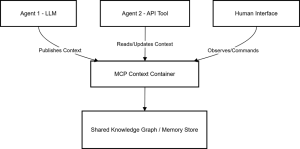
The Modal Context Protocol (MCP) is an open standard for contextual interoperability that lets agents, models, and tools exchange state in real time. It defines a shared Context Container, standardized Actions and Modalities, and a Transport Layer for communication; allowing any agent to read or write from a unified context.
Born from Modal Labs’ 2024 research and adopted in Anthropic’s Claude MCP SDK, the protocol is open-sourced under the MIT License and already forming the backbone of next-generation agent frameworks like OpenDevin and LangGraph.
Think of it as a common language for AI systems; one that standardizes how context flows between agents, just as HTTP standardized data exchange between websites.
- How MCP Works
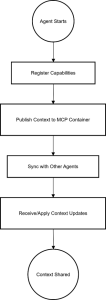
When an agent joins an MCP network, it first registers its capabilities; declaring what data it can consume and what actions it supports. It then publishes its local context to a shared container. As other agents join, the protocol synchronizes updates, ensuring everyone stays on the same page.
MCP supports multiple data modalities; from JSON schemas and text to file embeddings and command interfaces. This flexibility enables agents across different domains (vision, code, chat, and workflow automation) to collaborate seamlessly.
- MCP vs. Traditional Context Management
Traditional context management relies on ad-hoc synchronization; often through REST APIs, local databases, or vector stores. These setups lack standard schema definitions and rarely update in real time.
MCP, by contrast, treats context as a living shared object. Agents can subscribe, modify, or react to updates instantly.
| Feature | MCP | REST APIs | LangChain Memory | GraphQL Subscriptions |
| Context Standardization | Yes | No | No | Partial |
| Multi-Agent Sync | Yes | No | No | Limited |
| Real-time Updates | Yes | No | Limites | Yes |
| Schema Portability | JSON-LD | JSON | Custom | Custom |
| Open Standard | Yes | Yes | No | Yes |
In short: MCP is to agent communication what WebSockets were to the real-time web; fast, stateful, and standardized.
- Real-World Implementations and Use Cases
Anthropic’s Claude MCP SDK showcases the protocol in action. It allows Claude to access and update context across different tools; for instance, writing a document in VS Code while referencing tasks from Jira and messages from Slack.
Developers are rapidly adopting MCP through Modal Labs’ reference server and community bridges that connect it with frameworks like CrewAI and AIOS.
| Sector | Use Case | MCP Advantage |
| Software Development | Context-aware copilots | Unified state across IDE + Docs + Git |
| Customer Support | Multi-agent ticket handling | Shared memory across bots |
| Healthcare | Data-sharing agents | Schema-governed interoperability |
| Finance | Compliance-aware chatbots | Context validation and traceability |
The protocol is already being tested in enterprise sandbox environments, enabling smoother collaboration between heterogeneous AI systems.
- Governance, Security, and Compliance
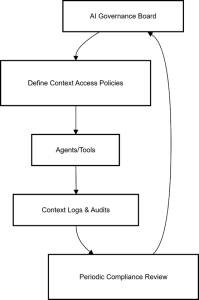
MCP was designed with governance in mind. Every state update can be digitally signed to verify authenticity, and contexts can be partitioned to enforce least-privilege access.
The protocol aligns with privacy and governance standards like GDPR and ISO 42001, making it enterprise-ready.
These features ensure context integrity, compliance auditability, and human-in-the-loop oversight; critical for regulated industries.
- Challenges and Limitations
MCP’s ecosystem is still emerging. Standardization between vendors remains incomplete, and domain-specific ontologies (like medical or legal schemas) need further definition. The synchronization layer can also add computational overhead for large-scale systems.
However, these are early-stage maturity challenges, not design flaws. As community adoption grows, tooling and optimization are likely to follow quickly; much like the evolution of REST and GraphQL in their early days.
- Expert Opinions
“MCP will likely become to multi-agent AI what HTTP was to the early Web; a foundational interoperability layer.”
– Dr. Ethan Zhang, AI Systems Architect, Stanford AI Lab (2025)
“Anthropic’s MCP SDK shows how cross-tool context can create truly continuous workflows.”
– Jane Roberts, CTO, Modal Labs
These insights capture MCP’s potential to serve as the contextual backbone for interoperable AI ecosystems.
- The Road Ahead
The MCP specification is tracking toward v1.0 in 2025, with cross-LLM adapters under development for OpenAI, Anthropic, and Mistral models. The roadmap also outlines governance extensions for enterprise deployments and context certification protocols for regulated sectors.
Looking further, MCP may soon integrate with standards like ISO/IEC 62577:2025 for AI agent governance, establishing a global baseline for safe, interoperable AI collaboration.
- Conclusion
The Modal Context Protocol marks a turning point in the evolution of AI architecture. By standardizing how context is shared, it allows agents, tools, and humans to collaborate within a single, coherent ecosystem.
MCP isn’t just another protocol; it’s the contextual connective tissue that could make truly composable AI possible. As the community refines the standard, its real impact will come when developers and enterprises start building with it; turning isolated intelligence into interoperable ecosystems.
