
The Invisible Grid: How Ambient Computing is Rewiring Reality
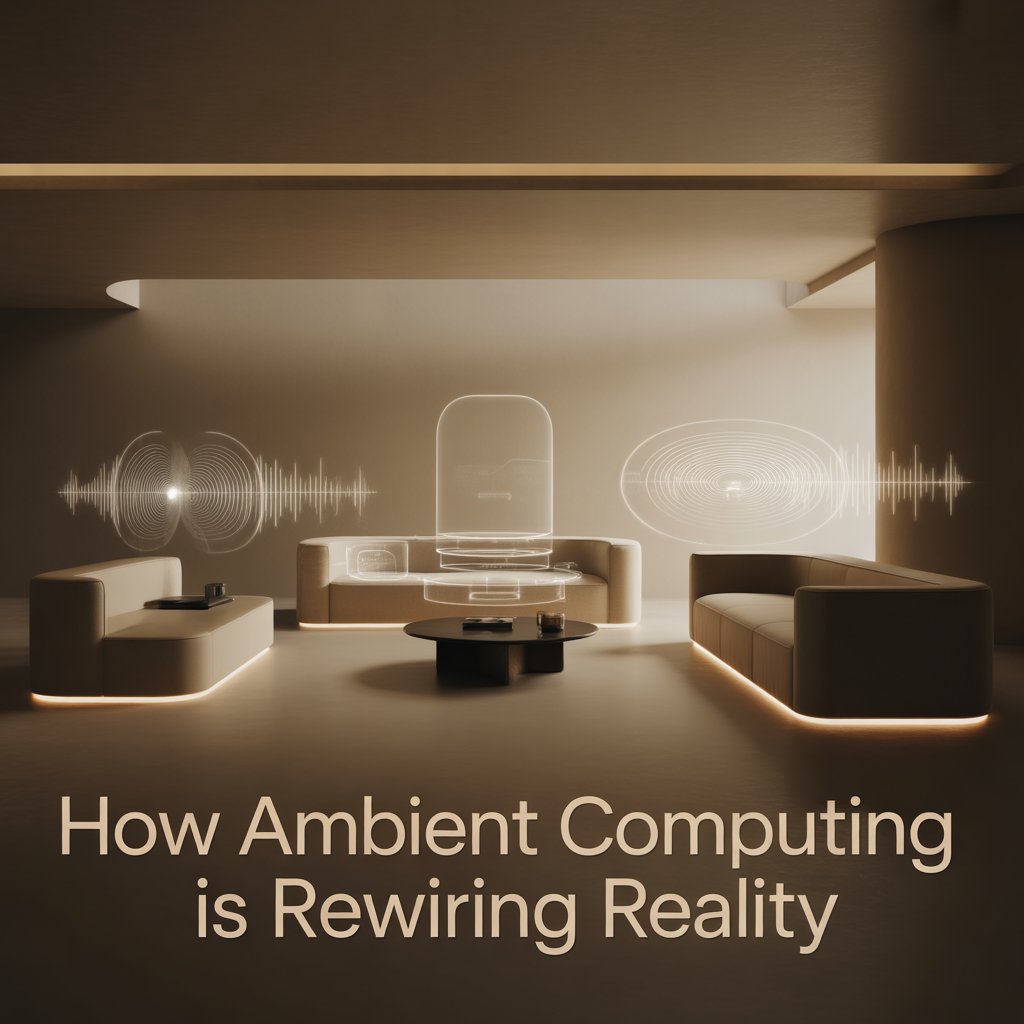
Welcome to the Disappearing Tech Revolution
Greetings Surge Community,
For decades, technology demanded our attention: screens to stare at, buttons to press, devices to charge. But something profound is happening, the most exciting tech is becoming invisible. Welcome to the era of ambient computing, where intelligence and connectivity weave themselves into our environments so seamlessly, we experience the magic without seeing the machinery.
1. The Architecture That Thinks
Imagine walking into a room that knows you. Not just your temperature preference, but your mood. Companies like Brilliant and Lutron are pushing beyond smart switches to create environmental systems that learn and adapt:
-
Lighting that automatically adjusts color temperature throughout the day, syncing with your circadian rhythm
-
Acoustic panels that subtly change porosity to optimize room sound for conversation, then for music, then for focus
-
Windows with electrochromic glass that tint not just based on sun position, but on the content being displayed on nearby surfaces
This isn’t home automation, it’s architectural intelligence.
2. Surface as Interface (Without Screens)
Why pull out a device when every surface can respond? Advancements in microwave radar sensors (like Google’s Soli, now finding new applications) and capacitive sensing mesh are turning ordinary materials into touch interfaces:
-
Your wooden desk recognizes objects placed on it and offers relevant controls
-
A fabric-covered wall becomes a gesture-controlled media center
-
Your car’s dashboard disappears entirely, with controls appearing only when needed on whatever surface your hand approaches
Displays are becoming the exception, not the rule.
3. The Energy Harvesting Ecosystem
The greatest barrier to invisible tech has always been power. No more. We’re entering an age of perpetual computing through multi-source energy harvesting:
-
Photovoltaic everywhere: Not just solar panels, but PV-integrated paints, window coatings, and fabrics
-
Thermoelectric generators capturing temperature differentials between indoor/outdoor or even body/air
-
Piezoelectric floors and RF harvesting from ambient Wi-Fi and cellular signals
-
Kinetic energy from everyday movement
These micro-harvesters work together, creating devices that never need charging—because they’re always charging.
4. Contextual Haptics: Feel the Information
When screens disappear, how do we receive information? Through spatial haptics. Ultrasound arrays (like those from Ultrahaptics) can create touch sensations mid-air. Wearable bands that use tactical illusions can make you feel like you’re turning a dial or pressing a button when there’s nothing there. Your environment doesn’t just sense you—it can touch back.
The Human Experience Shift
This invisible revolution changes our relationship with technology fundamentally:
-
From interaction to intuition: Tech responds to presence and intent, not just commands
-
From device-centric to environment-centric: Your “computer” is the room itself
-
From attention-demanding to attention-respecting: Technology serves without interrupting
The Takeaway: The most profound technological advance may be technology that knows when to disappear. We’re not just building smarter devices; we’re building smarter spaces that enhance human experience without the cognitive load of managing technology itself.
What disappears next might just surprise you.
Keep exploring (even when you can’t see what you’re looking for),
The TechnoSurge Crew
P.S. What’s one piece of visible technology you wish would just disappear? Share your thoughts and we might feature the best ideas in our next issue!
